
How Graphic T Shirts Began Raising Money for Nonprofits and Evolved Over Time

A donation receipt goes in a drawer. A graphic T-shirt walks through grocery stores, school drop-offs, charity runs, concerts, and neighborhood fundraisers.
That simple difference helps explain why graphic T-shirts became one of the most reliable fundraising tools for nonprofit organizations. They do two jobs at once. They raise money when someone buys one, and they keep telling the story every time someone wears it.
The history is not as neat as one single “first-ever” charity shirt. Local churches, civic groups, schools, and clubs printed basic shirts long before anyone kept clean records. But the first nonprofit graphic T-shirt model that looks very much like today’s cause-based fundraising shirts began to take shape in the 1970s, especially through environmental activism. One of the earliest and most influential examples was Greenpeace’s “Save the Whales” campaign, launched in 1975, which used bold, wearable graphics to fund and spread a mission.
From there, nonprofit T-shirts moved from protest circles to charity walks, awareness months, disaster relief drives, online campaigns, and limited-edition artist collaborations. The shirt became more than merchandise. It became a public badge of support.

The nonprofit T-shirt did not appear out of nowhere
The T-shirt started as underwear. In the early 20th century, it was valued because it was cheap, washable, and easy to wear. The U.S. Navy helped make the plain white T-shirt common as an undershirt, and by the mid-1900s, it had moved into everyday clothing.
Graphic printing changed its role.
By the 1940s and 1950s, shirts carried military designs, vacation slogans, college names, and political messages. The famous 1948 “Dew it with Dewey” shirt for presidential candidate Thomas Dewey is often cited as an early political campaign T-shirt. It was not a nonprofit fundraiser, but it showed something important: a shirt could turn a supporter into a walking message.
In the 1960s, screen printing became more accessible, and youth culture made graphic shirts louder, more personal, and more political. Bands, protest groups, civil rights organizers, anti-war activists, and environmental groups all saw the same opportunity. A shirt could carry a message without needing a newspaper ad, a billboard, or a microphone.
For nonprofits, that mattered. Many organizations did not have large media budgets. A shirt let supporters pay for the privilege of spreading the message.
That shift made the T-shirt unusually powerful. It was low-cost, easy to distribute, and emotionally direct. A good design could say, “I care about this,” without a long explanation.
The first widely recognizable nonprofit fundraising shirt came from cause activism
There is no universally documented first nonprofit fundraising T-shirt. The early history is scattered across local events, small print shops, volunteer groups, and short-run campaigns. Many designs were made, sold, worn out, and never archived.
Still, if the question is when nonprofit T-shirts became recognizable as a serious fundraising and awareness tool, the answer points strongly to the 1970s environmental movement.
The clearest early example is Greenpeace and its “Save the Whales” campaign. Greenpeace was founded in 1971, and its anti-whaling campaign became a defining public cause in 1975. Supporters wore shirts with direct, memorable graphics tied to whale protection and ocean activism. These shirts helped raise money, but they also helped make the cause visible far beyond the ships, docks, and protests where the campaign began.
That design model still shapes nonprofit apparel today:
A short phrase people remember
A clear cause symbol
A design that works from a distance
A shirt supporters feel proud to wear
A direct link between purchase and mission
Earlier charitable or civic shirts almost certainly existed. A local hospital auxiliary, neighborhood charity race, church mission trip, or service club may have sold printed shirts before Greenpeace’s whale campaign. But Greenpeace helped prove that a nonprofit graphic shirt could become part of a movement’s public identity.
The message was not hidden. It was printed across the chest.
The breakthrough was simple: the shirt turned giving into something visible, social, and repeatable.
That visibility gave nonprofits a tool commercial brands already understood. Clothing could create belonging. Nonprofits added moral purpose to it.
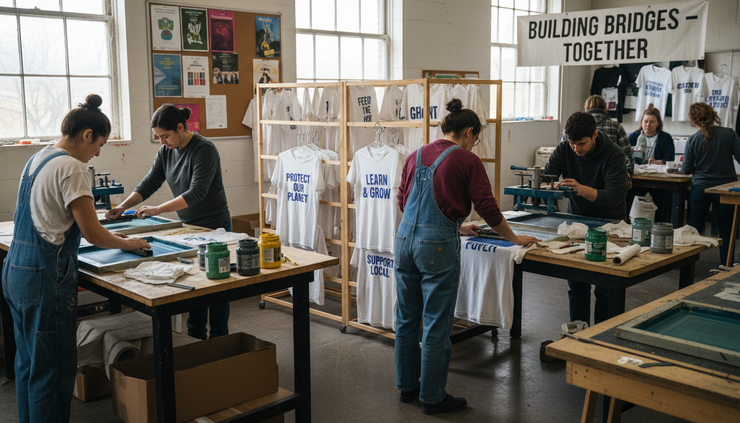
Why graphic T-shirts work so well for fundraising
A nonprofit T-shirt succeeds because it gives the donor something useful, but that is only the surface reason. The deeper reason is identity.
People support causes that connect to who they are, who they love, what they have survived, or what kind of world they want. A shirt lets them show that connection in a normal, everyday way.
They make giving tangible
Many donations are invisible. That is not a flaw, but it can make the moment feel abstract. A T-shirt gives the supporter a physical reminder of the gift.
For a nonprofit, that tangible exchange can lower hesitation. Someone who might pause before making a general donation may feel more comfortable buying a shirt, especially if the mission is clear.
The shirt says:
I contributed
I belong to this effort
I can keep showing support after the purchase
That is why charity runs, school fundraisers, animal shelters, disease awareness campaigns, and disaster relief efforts use shirts so often. The buyer gets more than cotton and ink. They get a sign of participation.
They spread the message without paid media
When someone wears a nonprofit shirt, the design may be seen by dozens of people in a single day. Most will not stop and ask about it, but some will. A strong shirt invites conversation.
That is especially useful for causes that depend on awareness. Breast cancer walks, AIDS awareness events, suicide prevention campaigns, environmental cleanups, food banks, and veterans’ organizations have all used apparel to make a cause more visible.
Good nonprofit shirts do not need to explain everything. They need to open a door.
They build community at events
Anyone who has attended a charity 5K, volunteer day, or awareness march has seen the effect. Matching shirts help people feel like part of a group.
They also make events photograph well, which matters for memory, local news, newsletters, and future fundraising. A crowd in shared shirts shows scale. It gives supporters proof that they are not alone.
That emotional proof helps people come back the next year.
They can produce strong margins when managed well
T-shirts are not magic. Poor planning can leave a nonprofit with boxes of unsold sizes and money tied up in inventory. But when campaigns are planned carefully, shirts can raise meaningful funds.
The most successful nonprofit shirt campaigns usually keep a tight grip on:
Print quantity
Size mix
Shirt quality
Pricing
Fulfillment
The clarity of the donation amount
Many modern campaigns use pre-orders or print-on-demand tools to avoid waste. That makes the fundraiser safer for small organizations.
The 1980s and 1990s made the cause shirt mainstream
By the 1980s, graphic T-shirts had become part of pop culture. Concert merch, athletic events, tourist shirts, and brand logos were everywhere. Nonprofits benefited from that shift because people were already used to wearing messages on clothing.
Large cause campaigns also showed how entertainment, media, and nonprofit fundraising could overlap. Band Aid in 1984 and Live Aid in 1985 raised money for famine relief in Ethiopia through music and mass public attention. Shirts tied to benefit concerts and relief efforts helped supporters mark their connection to the cause.
In the 1990s, awareness ribbons became powerful visual symbols. The red ribbon for AIDS awareness and the pink ribbon for breast cancer awareness became especially recognizable. Nonprofit apparel followed. Shirts began using a mix of symbols, slogans, event names, survivor language, and memorial designs.
This period helped establish several formats that are still common:
Fundraising shirt format | Why it worked |
Charity walk and run shirts | Participants received proof they took part and promoted next year’s event |
Awareness month shirts | Supporters could wear the cause during a focused public campaign |
Memorial shirts | Families and communities could honor a person while raising funds |
Benefit concert shirts | Fans could connect music, identity, and giving |
Volunteer team shirts | Nonprofits could create unity during service events |
The designs were often simple by today’s standards, but they worked because they were emotionally clear. A ribbon, a name, a date, a cause phrase, and a color could carry a lot of meaning.

Online tools changed the scale and speed of nonprofit shirt campaigns
The next major leap came when fundraising moved online.
Before online stores and print-on-demand services, nonprofits usually had to estimate demand, place a bulk order, store boxes, sell shirts in person, and handle leftovers. That system favored larger groups with space, volunteers, and cash up front.
Online tools changed the risk.
A small nonprofit could launch a shirt campaign, collect orders first, and print only what supporters bought. This opened the door for animal rescues, school clubs, mutual aid groups, rare disease foundations, and local relief funds to use shirts without acting like a full retail operation.
The design style changed too.
Earlier nonprofit shirts often looked like event souvenirs. Modern campaigns can look like streetwear, art prints, vintage tees, minimalist typography, or limited-edition drops. Some organizations work with illustrators, tattoo artists, musicians, athletes, or local designers. Others use simple text because the message itself is powerful enough.
Online campaigns also made urgency easier. A shirt could be available for two weeks only. Supporters had a clear reason to act now, and the nonprofit did not need to carry inventory afterward.
This worked especially well for disaster relief and emergency response. When a hurricane, wildfire, flood, or community crisis happens, supporters often want a fast way to help. A shirt campaign can raise funds and give people a shared symbol of care.
Still, the best campaigns are careful with transparency. Supporters want to know where the money goes. A vague “proceeds support the cause” is weaker than a clear statement such as “$12 from each shirt supports meal delivery” or “all net proceeds support shelter medical care.” Exact wording depends on the campaign, but clarity builds trust.
The best nonprofit shirts now balance design, ethics, and mission
Today, graphic T-shirts for nonprofit fundraising sit at the intersection of design, community, and values. Supporters expect more than a cheap shirt with a logo slapped on it.
They look for shirts they will actually wear.
That has pushed nonprofits to think more carefully about the full experience, from the blank garment to the artwork to the story behind the campaign.
Strong modern nonprofit shirts tend to have a few traits.
The message is easy to grasp.
A person should understand the core idea quickly. Complex mission statements rarely make strong shirts.
The design stands on its own.
People wear shirts that look good. A beautiful or clever design can reach people who might not have noticed the organization otherwise.
The cause connection is clear.
A shirt should not be so subtle that the mission disappears. The design can be artistic, but the fundraiser still needs meaning.
The quality is good enough to last.
A shirt that shrinks, fades, or feels uncomfortable stops spreading the message. Better quality can mean a higher price, but it often creates better long-term value.
The nonprofit avoids over-ordering.
Pre-orders, limited runs, and careful size planning reduce waste and protect funds.
The campaign tells buyers what their purchase does.
Supporters do not need a long report at checkout. They do need a clear promise.
The biggest progression is that nonprofit shirts have moved from basic awareness items to intentional community products. The shirt is no longer just a giveaway or souvenir. It is often part of a larger campaign, tied to storytelling, events, donor updates, and repeat engagement.
That is why graphic T-shirts still work after decades of use. The format has changed, but the human appeal has stayed the same.
People want to help. They also want to feel connected to the help they give.

The takeaway for nonprofits today
The success of graphic T-shirts in nonprofit fundraising comes from a rare mix of usefulness, emotion, and visibility. A shirt can raise money at the point of sale, then keep working every time it is worn.
The first clear nonprofit model did not come from a polished retail strategy. It came from cause activism, especially the 1975 Greenpeace “Save the Whales” campaign, where a bold graphic helped carry a mission into public life. Since then, nonprofit shirts have grown through charity events, awareness campaigns, benefit concerts, online fundraisers, artist collaborations, and print-on-demand campaigns.
The lesson is simple. A successful fundraising shirt is not just merchandise. It is a small piece of the mission that supporters can take with them.
When the design is clear, the cause is honest, and the shirt is something people want to wear, cotton and ink can carry a nonprofit’s message much farther than a donation page alone.
Let Act Out Tees design for your next event - Subject: Fundraiser Design -
Contact Us At: actouttees@gmail.com


Comments